
Thickness is the single most debated spec when choosing a standing mat. Go too thin and the mat offers minimal relief over a bare floor. Go too thick and the surface becomes unstable, straining the ankles and reducing posture quality.
The ideal range sits between 0.5 and 0.75 inches for most desk workers. That window delivers enough compression to absorb ground reaction force while keeping the surface firm enough for safe, comfortable standing throughout the day.
Why Thickness Matters More Than People Realize
Most buyers focus on price or brand when choosing a mat. Floor mat for standing desks thickness is the spec that actually determines performance. It controls three things simultaneously:
- Compression depth: How much the mat gives underfoot when body weight is applied
- Surface stability: How much ground contact the feet maintain during standing
- Fatigue reduction: How effectively the mat triggers the micro-movements that keep circulation active
A mat that gets all three right feels almost invisible underfoot. You are not thinking about the mat. You are just standing comfortably for longer than you would on a bare floor.
Get thickness wrong in either direction and the mat becomes the problem. Too thin and you feel every hard surface vibration through your heels. Too thick and you are constantly making small balance corrections that tire out the ankles and calves faster than bare floor standing would.
The Thickness Ranges Explained
Understanding what each thickness range actually delivers helps narrow the choice quickly.
Under 0.5 inches
- Provides minimal cushioning
- Better than bare floor for short intervals only
- Does not activate meaningful micro-movement in the legs
- Suitable for light kitchen use, not full workday standing
0.5 to 0.75 inches
- The practical sweet spot for standing desk use
- Enough compression to absorb impact without bottoming out
- Maintains good ground contact for balance and posture
- Works for most body weights and foot types
- The range where anti-fatigue performance is most consistent
0.75 to 1 inch
- Works well for heavier users or those standing on concrete floors
- Starts to feel slightly unstable for lighter individuals
- Requires firmer density foam to avoid excessive compression
- Better suited to industrial or workshop environments than home offices
Over 1 inch
- Too soft for most standing desk applications
- Reduces ankle stability significantly
- Increases muscle fatigue in the lower leg rather than reducing it
- Not recommended for prolonged desk standing regardless of body weight
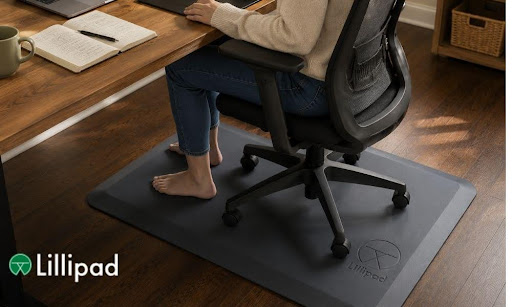
The Lillipad standing mat measures 0.6 inches thick, placing it directly in the optimal range. That thickness works across a wide range of users without compromising stability or cushioning.
How Body Weight Affects the Right Thickness
Thickness interacts with body weight in a straightforward way. Heavier users compress a mat more deeply than lighter users. A mat at 0.5 inches that works well for a 130-pound user may bottom out under a 220-pound user, providing little cushioning after the first few minutes.
General guidance by body weight:
- Under 150 lbs: 0.5 to 0.6 inches provides adequate cushioning with good stability
- 150 to 200 lbs: 0.6 to 0.75 inches balances compression and ground feel effectively
- Over 200 lbs: 0.75 inches with high-density foam prevents bottoming out during long sessions
The density of the foam matters as much as the thickness at heavier body weights. A high-density mat at 0.6 inches will outperform a low-density mat at 0.75 inches for heavier users every time.
Thickness Versus Density: Understanding the Difference
Thickness and density are related but not the same thing. Thickness is the physical measurement of the mat. Density is how much the foam resists compression under load.
A thick mat with low density compresses fully and offers no real support. A thinner mat with high density maintains its cushioning properties throughout the day and across years of use.
How to check density without lab equipment:
- Press your thumb firmly into the center of the mat. It should indent but not collapse to the floor.
- Stand on the mat and check that you can still feel the ground beneath you. Full compression means the density is too low.
- Step off and watch the mat. It should return to its original shape within a few seconds.
When both thickness and density are correct, the mat performs consistently from the first hour of use to the last, and from the first week of ownership to years later.
Does Footwear Change the Ideal Thickness?
Yes. Footwear adds its own layer of cushioning between the foot and the mat. Thick-soled shoes on a thick mat create a combined softness that reduces stability and ground contact significantly.
Adjust thickness based on footwear:
- Barefoot or thin soles: 0.6 to 0.75 inches works well
- Standard office shoes or sneakers: 0.5 to 0.6 inches is sufficient
- Thick-soled shoes or boots: Stay at 0.5 inches to maintain enough ground contact for balance
Most home office workers standing in socks or light indoor shoes will find 0.6 inches the most comfortable and stable option across a full workday.
Floor Type Also Plays a Role
The floor beneath the mat affects how thickness performs in practice. On a hard, flat surface like tile or hardwood, the mat delivers its full cushioning effect. On carpet, the mat sinks slightly into the pile, which effectively increases the total softness underfoot.
On carpeted floors:
- Choose a mat at the lower end of the thickness range, around 0.5 to 0.6 inches
- Look for a non-slip base designed for carpet use
- Avoid gel-core mats on carpet, as they sit unevenly and increase instability
On hard floors, the full 0.5 to 0.75 inch range performs as expected without adjustment.
Get the Foundation Right From the Start
Thickness is not a detail. It is the foundation of how well a standing mat performs across every session. The right thickness for most desk workers is 0.6 inches, paired with high-density foam and a beveled edge design.
The Occupational Safety and Health Administration notes that prolonged standing on hard surfaces contributes to lower limb fatigue and musculoskeletal discomfort. Proper floor cushioning is listed among the workplace ergonomic controls recommended to reduce those risks.
Lillipad’s anti-fatigue mat hits that specification precisely. It is built to pair with our height-adjustable standing desk and sits within the leg frame cleanly at any height. Browse our full range of ergonomic desk accessories and build a setup that supports you from the floor up.